 QaranJobs.com – somali jobs – somalijobs – qaranjobs – Qaran Jobs Somali Jobs
Oxfam
Gender in Emergencies – Somaliland
Job Description
Terms of Reference, Baseline Study
“Gender in Emergencies”
- INTRODUCTION
Oxfam in Somalia and Oxfam Canada work together as part of the international Oxfam Confederation, networked in over 90 countries as part of a global movement for change. Our mission is to build lasting solutions to poverty and injustice with a focus on improving the lives and promoting the rights of women and girls. We work directly with communities, partners, and women’s rights organizations to challenge the systems that perpetuate inequality and keep people poor. Together we seek to influence those in power to ensure that women trapped in poverty have a say in the critical decisions that affect them, their families, and entire communities.
- BACKGROUND
The humanitarian situation in Somalia has become increasingly fragile following consecutive failed or below normal rainy seasons. Climate change, conflict and insecurity are continuously affecting the livelihoods of Somalia’s pastoralist and farming communities, leading to displacement – on top of conflict/violence in many parts of the country, including on land/resources and between clans and government and non-state armed actors. Recurring and worsening drought conditions lead to massive crop failures and reduced rural employment opportunities, widespread shortages of water and pasture, rapidly diminishing food access among poor households as staple food prices continue to rise sharply and livestock prices decrease significantly. The compounding impacts of these shocks continue to erode coping strategies and undermine resilience against future crises. The number of people in need continues to increase as reflected in the past 3 years from 5.2 M in 2020 and 5.9 M in 2021 and an estimated 7.7 M people in 2022.
Gender in Emergencies (GIE) Project
This project is built around highly complementary interventions in three countries Bangladesh, Somalia and South Sudan with the understanding that increasing women’s voices in humanitarian decision-making is essential for any response to adequately address the needs of women and girls. Working with Women’s Rights Actors (WRAs) at different levels and across borders, is intended to generate context specific as well as regional learnings that have the potential to more effectively address the similar issues that women and girls in these settings may be facing. This Somalia component of this project will target two districts of Ainabo and Eil-afweyn which are under Sool and Sanaag regions. The two districts are among the worst drought affected areas in Somaliland. In these regions, drought has continued to exacerbate existing vulnerabilities particularly among women
- Programming Vision and Approach
The central vision of the Gender in Emergencies project is strengthened women’s leadership and women rights in humanitarian situation in Somaliland focusing more in Sool and Sanaag regions. The project has inter-linked intermediate outcomes that contribute to address barriers to gender inequality in humanitarian settings. In one dimension, the project will seek transformational changes towards women leadership in all cycles of humanitarian programs. This means women would be empowered and given platforms so they can make quality and informed decisions during program design, implementation, and closure. As there is limited knowledge & learning on how best this can be achieved, the project will invest in facilitating to generate learning and knowledge.
Following are the project intermediate outcomes:
- Intermediate Outcome 1100: Increased participation of women in decision making groups/platforms in the humanitarian program cycle
- Intermediate Outcome 1200: Increased access to feminist knowledge, including best and emerging practice on gender in emergencies, by humanitarian actors (including WRAs)-
The Project will use holistic and transformative approaches to deliver impactful programs. As this is a standalone project, all project activities will use a gender sensitive approach, that is gender responsive and transformative, to make sure women and girls are put at the centre. Furthermore, project will be guided by Oxfam’s Transformative Leadership for Women’s Rights Framework and Gender in Humanitarian Leadership Framework
- Project Partners
While Oxfam in Somalia and Oxfam Canada are accountable for the overall management of the project in Somalia, Women Rights Organizations (WROs) at national, regional and district level will play a key role. The project will specifically empower community-based organizations. Further, the Ministry of Employment, Social Affairs and Family of the Republic of Somaliland (MESAF) will play a national advocacy role. Each of the partners will have specific and context based knowledge that will contribute the overall objective of the project.
- Purpose and Scope
Overall objective: to provide contextual analysis of the voice, influence, and role of women in humanitarian leadership and decision making. The baseline report will document roles and influences of different stakeholders including INGO’s, WROs, CBOs, traditional and religious leaders and community men and women to increase women’s leadership in emergency situations.
In doing so, Oxfam expects the consultant(s) leading the baseline to use a gender lens.
In its work, Oxfam seeks to apply a Feminist Approach to Monitoring, Evaluation, Accountability and Learning (FMEAL). In doing so, it prioritizes seven key foundations, including:
- Understanding feminist MEAL as an approach,
- Positioning MEAL as an integral part of social transformation,
- Shifting power to participants in evaluations,
- Understanding the role of the evaluator as a facilitator,
- Valuing collective, context-driven knowledge generation,
- Providing a learning orientation to evaluative exercises, and
- Rooting feminist MEAL in safe programming, guided by ‘do no harm’.
The successful consultant(s) should reflect these foundations in their proposal and subsequent work. The online Measuring Change with a Feminist Lens profile highlights some examples of MEAL work that Oxfam has previously done using a feminist approach
- Objectives of the Final Review
Overall, Oxfam and its partners envision a feminist baseline study that draws on a range of stakeholder voices and contextual experiences to:
- Provide deeper insights of the importance of women’s leadership and participation in humanitarian decision making and actions.
- Provide benchmarking for all project qualitative and quantitative indicators and update performance measurement framework.
- Provide analysis of the voice, decision making role and power influence women have influence humanitarian actions.
- Examine the roles and influence of women stakeholders on women’s leadership in emergency programing or situations. The report will provide advice on how to involve and role of stakeholders towards improving women’s leadership in humanitarian actions.
- Document best practices and challenges to improve women’s leadership and decisions in all stages of emergencies response.
- Review project logical frame, outcomes and activities and examine their effectiveness suitability and relevance. The consultant will provide critical review and recommendation what could be feasible, working or not working.
- The baseline would provide richer analysis on challenges, opportunities and learning on how project can integrate transformative and gender policies of Oxfam.
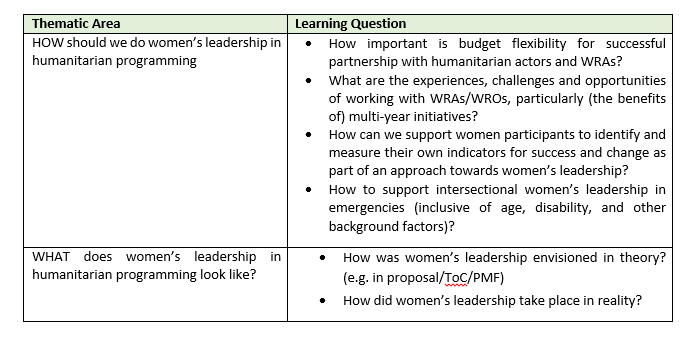
As this project will put learning and knowledge as integral part, Oxfam together with its project partners has developed a learning agenda for the project. The learning agenda will guide the learning efforts of the project. The consultant will review the learning agenda and would provide critical review on applicability, relevance and practicality of the learning questions. Oxfam is also open to the successful consultant(s) to propose further learning questions related to these specific objectives.
- Methodology
The baseline will utilize both quantitative and qualitative methods of analysis for producing a final report for the baseline. As such, in terms of data collection tools, the consultant will conduct survey, focus groups discussions, key informative interviews and field observations.
The survey is intended provide initial data on indicators in the PMF. The consultant(s) should be prepared to use either SurveyCTO, Kobo or other digital data collection digital software for data collection and quality checks. Oxfam has licenses for SurveyCTO. At Oxfam, our default position is to use cluster sampling to select the statistically representative sample of direct reach within a project’s implementation area.
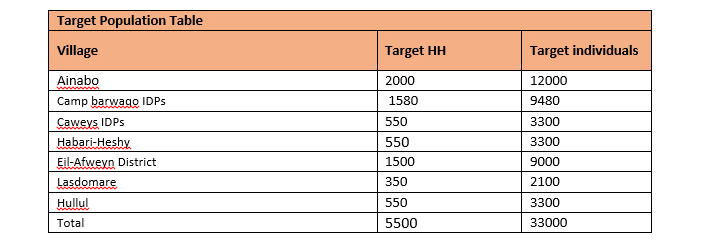
Using a 95 percent confidence interval, a 5 percent margin of error, and a 50 percent response distribution. The number of Focus Group Discussion (FGDs) to be held in the different locations should be between 6 to 8 of between 10 to 12 participants each, based on information need for analysis. Additionally, the number of Key Informant Interviews (KIIs) should not exceed 21 and not less than 14 in all target locations. The gender disaggregation should be 50/50 percent per location including the surveys data collection
- Guiding Principles and Values
The successful consultant(s) should include and address all potential ethical issues related to this review in its proposal and subsequent inception report. Additionally, the successful consultant(s) are expected to undertake the Gender in Emergencies project baseline study research with high respect given to transparency, cost-effectiveness, gender transformative potential, and collaboration with a range of stakeholders.
- Key Activities and Deliverables
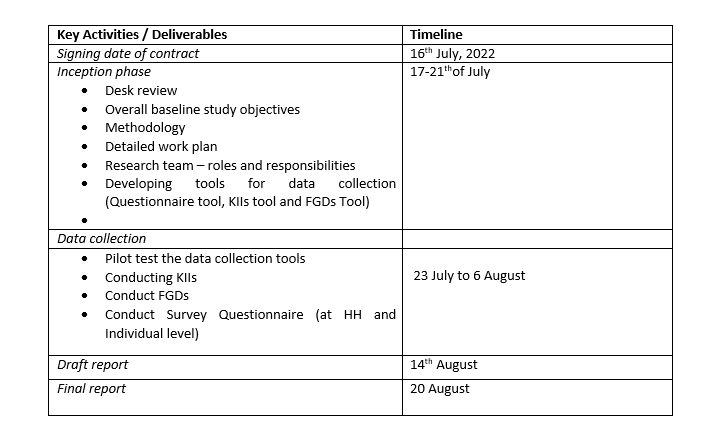
The project baseline study will start upon signing of the contract between Oxfam and the successful consultant(s) or an otherwise agreed upon date. The exact due dates for all deliverables will be finalized with Oxfam prior to submitting the inception report, so long as the dates continue to fall within the broad start and finish dates of the consultancy.
Oxfam envisions the review as a collaborative undertaking between itself, partner staff in Somaliland Country Office, and the successful consultant(s). We expect that the selected consultant(s) will engage with and provide feedback on a continual basis. On our part, we commit to collaborating with the selected individual/team and to providing sufficient time for a back-and-forth approach.
*Note that timelines below could change as a result of travel and activity restrictions associated with the COVID-19 pandemic.
- Inception Report
The inception phase will begin with a thorough desk review of existing project documents and current research on Gender in Emergencies in Somalia. Based on this analysis, the inception report will include:
- Updated learning questions,
- Roles and responsibilities of team members executing the work,
- Data collection tools (a survey and supporting qualitative tools),
- Updated budget,
- A proposed schedule of meetings with key Oxfam staff to check progress and provide updates throughout all phases of the work, and
- A detailed table of contents for the final report
In-country data collection can only begin after Oxfam approves the inception report.
- Final Report
The final report will provide triangulated findings from the survey, FGDs and KII. The final report will provide insight into the objectives listed on page 3 of this ToR. The final report must be copy edited and laid out in a final format.
- Annexes to the Final Report
The final report shall also include a number of annexes, which will provide context to the report’s findings and recommendations. Suggested annexes include:
- Terms of Reference for the final review.
- Final review inception report.
- Data collection tools, including survey and qualitative tools.
- List of individuals and stakeholder groups consulted.
- List of supporting documentation reviewed.
Skills and Qualifications
The consultancy can include different team members. Key competencies of the team include:
- Strong experience designing and leading research relating to gender with the application of feminist research approaches, particularly focusing on women empowerment and participation in humanitarian decision making.
- Experience utilizing feminist MEAL principles and practices.
- Ability to facilitate and relate to stakeholders at multiple levels and in diverse contexts.
- Proven ability to engage in quantitative data analysis, with preference given to experience with SurveyCTO or LogAlto or Kobo toolbox.
- Strong written and verbal communication and presentation skills in Somali and English.
- Sensitivity to cultural and historical contexts in the data collection and analysis process.
- Strong preference for teams that include members with experience conducting research in Somaliland Eastern regions particularly Sool and Sanaag, respectively of Ainabo and El-afwayn district and sub-villages and IDPs hosted in the respected districts
- Members that have at least a high-school certificate with good communication and interpersonal skills and proven knowledge cultural behaviors of the target areas communities.
How to apply
Consultants meeting the above criteria are invited to submit a proposal by email to:
SOM-Consultancies@oxfam.org with the subject line: Baseline Study – Gender in Emergencies Project. Proposals should be received no later than 11th of July 2022 at 5:00pm. The body of the proposal should be no longer than 7-10 pages and should include the following:
- A cover letter outlining relevant experience in similar studies, including experience reviewing similar Gender in Emergencies project work.
- An outline of the study approach, highlighting proposed research questions, feminist methodological approach, data analysis plan, potential technical and operational challenges, and strategies to ensure timely, high-quality deliverables.
- A list of key activities, linked to the proposed activities, within a scheduled timeframe.
- A staffing and management plan, including details of team composition and specific qualifications of key staff.
The proposal should also include Annexes, which are not included in the page limit, such as:
- An estimated budget, including personnel, tax and other cost associated
- List of three (3) references who can attest to the team’s experience and expertise as it relates to this project (including daytime phone numbers and email contacts).
- CVs of the review team, outlining previous evaluation experience and accomplishments demonstrating the skills and knowledge needed to fulfill the Terms of Reference.
- Preferred: Two (2) examples of reviews recently completed by the consultant(s). If possible, at least one should be relevant, or similar to, the subject of this study.
Oxfam will review all proposals closely against this outline.

………………………………………………………………………………………
QaranJobs.com
………………………………………………………………………………………
PLEASE JOIN US – QARAN JOBS
Follow us on our Social Media:
Telegram: https://t.me/qaran_jobs
Facebook Page: https://www.facebook.com/QaranJobs.so
Facebook Group: https://www.facebook.com/groups/somaliajobs
Linkedin: https://so.linkedin.com/company/qaranjobs
Twitter: https://twitter.com/QaranJobs
Instagram: https://www.instagram.com/qaranjobs
Application: https://play.google.com/store/apps/details?id=com.qaran.jobs
………………………………………………………………………………………
To apply for this job email your details to SOM-Consultancies@oxfam.org