 QaranJobs.com – somali jobs – somalijobs – qaranjobs – Qaran Jobs Somali Jobs

Government Of Somaliland (GoSL)
Terms of Reference for Assist 12 districts to carry out climate change-related risks/vulnerabilities assessments and develop and adapt climate adaptation plans – Hargeisa, Somaliland
Republic of Somaliland
Ministry of Environment and Climate Change
Terms of Reference:
Assist 12 districts to carry out climate change-related risks/vulnerabilities assessments and develop and adapt climate adaptation plans.
Application deadline: 12 October, 2022
Type of Contract:
Local Consultancy
Duration of the assignment:
45 days
Duty station:
Hargeisa – Somaliland
Supervisor:
Director General MOECC
Background
Somaliland has a fragile and vulnerable environment with persistent droughts, intermittent floods and other man-made disasters. But in recent years, as the impacts of extreme droughts have begun to have a devastating effect, partially because of the climate change, already stressed communities have been pushed to the limit of their adaptation and coping capacity. Somaliland economy is mainly dependent on livestock and agriculture; and in the case of the most common climate-related shocks (such as drought and flood), households generally experience a management in income and production, largely related to a decline in weather-dependent activities, such as farming and livestock production both are rain dependent. This usually causes a devastating direct effect on large numbers of Somaliland communities and ultimately on the whole country. Local governments representing districts administrations are well positioned to manage these climate related disasters and try to reduce risks in local areas, since they are familiar with (and sometimes responsible for) both the disaster risks experienced, as well as the resources and opportunities available to identify and manage those risks. Similarly, in the areas that are prone to climate disasters, it is critical that intergovernmental responsibilities be delineated clearly and understood at all levels of government.
Although Somaliland local governments are under pressure to ensure social security and services to the increasing number of people who have settled in the towns, those forced to move from areas affected by drought, conflict and the displaced people crossing from the borders of the neighbouring countries. Still, the protection of all such groups against climate-related shocks, the ability to help them to manage risks, and provide them with opportunities to overcome problems of inequality, vulnerability, exclusion and resilience are all another important challenges that local governments can and should help to address.
In their mandates as in LG Law No. 23, Somaliland local governments currently deal with all types of emergencies and disasters, including climate related shocks (such droughts, floods). Local governments also serve the key functions of ensuring a link between local, community-based organizations, regional bodies and central government authorities. The implementation of disaster management in local areas also relies on the central government establishing a central level strategy that enables decentralized decision-making, and provides resources for local planning, assessment and intervention. However, it is at the local level that development planning first takes place and the integration between climate related disaster management and development is supposed to be realized.
Considering those compounding effects of the recurrent drought and the exposure to floods, the vulnerability of Somaliland local institutions with regard to such disasters, and the insufficient capacity to respond to these emergencies, there is a strong strategic rationale, as well as clear stakeholder demand, for JPLG III to enhance the overall climate preparedness and response capacity of local government structures.
- Programme Interventions
JPLGIII recognizes the imperative to break the cycle of the impact of natural disasters on the population of Somaliland and the crucial role local authorities can play in moving from humanitarian to development responses. The JPLG III programme document includes interventions on the support of the Local Government Emergency Management and disaster preparedness based on the findings mobilized in the new programme, as it represents a new area of engagement in the programme document.
JPLG III Interventions will support the existing operational mechanisms, systems and processes that can serve as vehicles for the provision of shock-responsive, predictable social protection and resilience investments. The programme will particularly, support the coordination, facilitation, and capacity support, for the implementation of the policy and delivery of any related safety nets, with a focus on districts affected by recurrent shocks, such as floods and droughts.
This will be further supported by a focus on climate disaster preparedness and management, with JPLG
Assisting local governments through the Ministry of Environment and Climate Change to:
- Support the planning and delivery of services that are more sustainable, relevant to the local context, accessible to all, risk-informed, and quicker to adapt to shocks and stresses;
- Integrate drought and flood relief measures into local government systems for planning, and strengthen their resilience and adaptive capacity to climate change;
- Better coordinate development, disaster preparedness, and response efforts.
Assignment Objectives
General Objective
The overall objective of this assignment is to build Somaliland Local Government’s capacities to contribute to the growing global effort to reduce the impact of climate change.
Specific Objective
MOECC will support 12 districts (Hargeisa, Buroa, Borama, Berbera, Gabiley, Zeila, Odweine, Sheikh, Baki, Lughaya, Bailligubadle and Salahley) carry out climate change related risks/vulnerabilities assessment and develop actionable climate adaptation plan for each district.
Scope of the Work
- The institutional assessment at the district level is to identify the strengths and weaknesses of the districts in dealing with climate-related disasters and their role in overall Disaster Risk Management. What are the roles and responsibilities and who is doing what? And what capacities do districts have and what capacities are they lacking, with the objective of strengthening the capacity of districts?
- Understanding the district vulnerability profile, for examples which communities and villages are most affected by the climate-related shocks.
- The livelihood activities and the location and risk profiles of the most vulnerable groups (or sectors), and to link this information to the hazard exposure maps.
- Information about the impacts of past disasters, responses taken, and lessons learned is equally important.
- Develop actionable climate adaptation plans and recommend ways to mainstream climate action plans into the District Development Plans (DDFs)
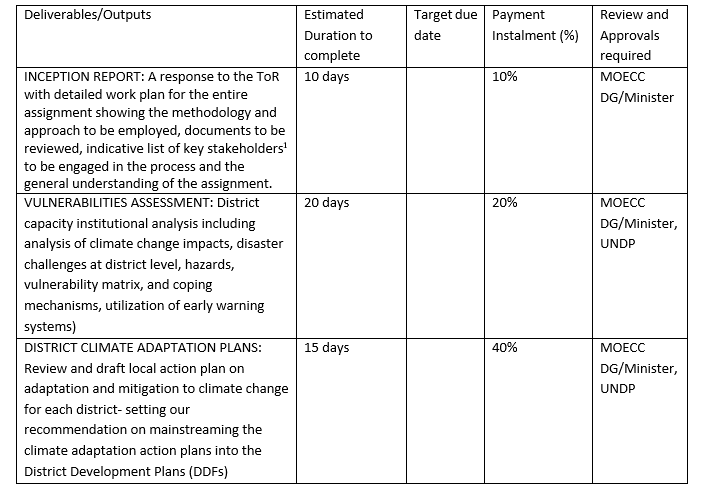
Key deliverables, payments and target dates
Eligibility Requirements
Only those consultancy firm(s)/institutions who satisfy the following requirements will be eligible for selection process.
- Registered as a legal entity in Somaliland.
- Proven record in conducting similar work, with high-quality data collection, research and analysis and delivering support services to development organizations and demonstrated sufficient managerial and technical capacity of personnel with the required qualifications and expertise to undertake this assignment, with particular expertise around humanitarian policy, disaster risk management, emergency programming and climate change adaptation.
- Extensive professional expertise on climate change is an added advantage.
- Be able to identify and submit the CVs of two or more resource people in the organization to fill the following roles: with the following qualifications.
Skills and Qualifications
A Master’s degree from a leading University in Public Policy, Political Science, Social Science, and or climate change management and Environmental Sustainability.
Degrees and trainings in Disaster Risk Management are considered an added advantage.
A minimum of 7 years’ experience with University graduation preferably in the area of Disaster Risk Management and or Disaster risk response.
Prior Experience working in Somaliland.
How to apply
Interested local consultancy firms are expected to submit their applications, to urban.moecc@sldgov.org with copy (cc) to dg.moecc@sldgov.org. The Closing date will be 12 October, 2022. Kindly indicate the position title on the subject line when applying.
NB: Only shortlisted candidates will be contacted.
The list of documents to be reviewed and the list of stakeholders will be discussed and agreed on between the programme and the contractor.

QaranJobs.com
………………………………………………………………………………………
PLEASE JOIN US – QARAN JOBS
Follow us on our Social Media:
Telegram: https://t.me/qaran_jobs
Facebook Page: https://www.facebook.com/QaranJobs.so
Facebook Group 1: https://www.facebook.com/groups/somaliajobs
Facebook Group 2: https://www.facebook.com/groups/qaranjobs
Linkedin: https://so.linkedin.com/company/qaranjobs
Twitter: https://twitter.com/qaran_jobs
Instagram: https://www.instagram.com/qaranjobs
Application: https://play.google.com/store/apps/details?id=com.qaran.jobs
To apply for this job email your details to urban.moecc@sldgov.org