 QaranJobs.com – somali jobs – somalijobs – qaranjobs – Qaran Jobs Somali Jobs

Government Of Somaliland (GoSL)
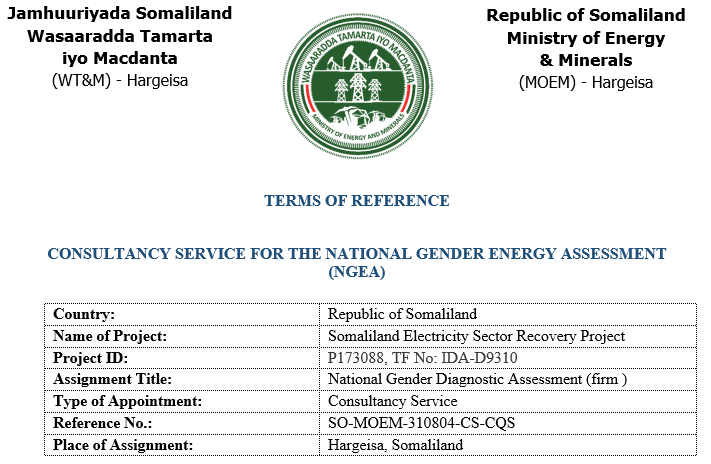
National Gender Energy Assessment (Firm) – Hargeisa, Somaliland
- Background
The Government of Somaliland has received a grant from the World Bank to implement the Somali Electricity Sector Recovery Project (SESRP). The Project Development Objective of SESRP is to increase access to electricity services and to re-establish the electricity supply industry in the Project Areas.
The Ministry of Energy and Minerals (the Ministry) has established a Project Implementation Unit (PIU) to carry out the day-to-day activities of project planning, coordination, and implementation of the Somali Electricity Sector Recovery Project.
The project comprises of the following four components: (i) Sub-transmission and distribution network reconstruction, reinforcement, and operations efficiency in the major load centers of Hargeisa; (ii) Hybridization and battery storage systems for mini grids; (iii) Stand-alone solar off-grid access to public institutions (Health and Education); (iv) Institutional Development and Capacity Building.
The Ministry of energy and minerals intends to apply part of the proceeds of this grant to engage to competitively recruit a firm (the “Consultant”) to conduct a National Gender and Energy Assessment to understand the gender disparities that currently exist in the energy sector of Somaliland.
Under the guidance of the GoSL, the Consulting Firm will be responsible for the successful Gender and Energy assessment, launch, and submission of the final report of the National Gender and Energy assessment.
The Objective of The National Gender and Energy Assessment will provide detailed analysis on the preliminary assessed components, as well the socio-economic positioning of women, norms of assigned gender roles, sector participation rates, inheritance laws, decision making roles, challenges faced by female headed households, skill enhancement availability, and safety of vulnerable women; and how the aforementioned affects access to clean energy and meaningful participation of women in the energy sector.
The consulting firm will be engaged for a period of 12 Months from commencement.
The technical specialist shall perform all other specific tasks detailed in the Terms of Reference (TOR) for the assignment that can be found at the following website: www.moem-sl.com and www.moem.govsomaliland.org or can be provided upon submission of an application in person or by e-mail provided below.
- BACKGROUND
The Energy Sector of Somaliland has overcome many challenges over the past decade. The Government has established the Ministry of Energy and Minerals (MOEM) that has the mandate to oversee the sector and the newly formed Somaliland Energy Commission (SEC) responsible for sector regulations. In addition, generation, transmission, distribution[i] and revenue collection is operated by the privately owned service providers known as electricity service providers (ESP). To strengthen the legal and policy framework, the National Energy Policy was also approved by the cabinet in 2010, the Electrical Energy Act was passed in 2018, and the best practice guideline for distribution was launched in 2018; they remain as the sector governing documents.
Others such as the power master plan, the geospatial electrification plan and the national MV -LV GIS mapping were all finalized with the support of development partners such as the World Bank. Alongside this was the reduction of electricity tariff by 50% – 30% in all major towns of Somaliland, improving the livelihoods of the population and creating access to new connections.
Women account for 50% of the population in Somaliland and the Ministry of Planning has recently announced gender as an independent sector; in support of this some of the core values of the Ministry of Energy and Minerals emphasize inclusivity and gender equity. Despite all of the abovementioned achievements, gender mainstreaming is still derelict in an obvious manner and women consequently, still face numerous challenges for instance the employment ratio to men, equal opportunities to higher education, decision making roles, and access to energy, affordability and service quality.
Although, women are recognized as powerful agents of change in the energy sector, commitments to increasing women’s participations in all aspects of the sector is vital to achieving gender responsive projects and programs to support energy infrastructure and services. In order to understand some of the gender gaps in the energy sector and to start exploring the gender energy nexus, the Ministry of Energy and Minerals conducted a preliminary gender assessment in 2021 in four areas i)Educational Attainment; ii)Employment Opportunity; iii)Skill Gap and iv)Policy framework. One of the recommendations of the assessment was to further conduct a detailed gender diagnostic assessment in the untapped areas of the nexus, to better inform the sector’s gender action plan awaiting implementation to focus on strategic approach to mainstreaming.
- SESRP Overview
Ministry of Energy and Minerals (MoEM) is the highest authority and policy making institution in Somaliland energy sector planning and approvals, the MoEM is mandated the sector planning & implementation activities and has the responsibility to set the overall objectives of the energy sector development implementation plans. So, the Government of Somaliland (GoSL) has secured a grant from the World Bank to implement the Somaliland Electricity Sector Recovery Project (SESRP).
The SESRP Project Development Objective is to increase access, to lower cost and cleaner electricity supply in the project areas and to reestablish the electricity supply industry. The SESRP project comprises of the following four main components:
- Component 1 – Sub-transmission and distribution network reconstruction, reinforcement, and operations efficiency in the major load center of Hargeisa.
This component will improve network reliability and operational efficiency by interconnecting the current ESPs’ distribution networks and existing generation to optimize overall distribution network operations. These activities will support the ESPs to (a) decrease the cost of operations (increased generation efficiency, reduction in distribution network losses, and distribution network duplications) and (b) improve electricity supply and reliability. This component has two sub-components: (i) Generator Synchronization and Automation, and (ii) Sub transmission and Distribution network interconnection in the major load center of Hargeisa.
- Component 2 – Hybridization and battery storage systems for mini grids.
This component will support activities aimed at the hybridization and optimization of existing mini grids. It will support installation of Battery Energy Storage Systems (BESS) and Solar Photovoltaic (SPV) systems at existing diesel-based generation stations in selected load centers. This component aims at increasing the efficiency of the existing hybrid mini grids (diesel and solar) by optimizing the generation capacity and, where possible, reducing the diesel consumption by augmenting the installed capacity with BESS and additional SPV generation. Such hybrid opportunities offer significant improvements in fuel efficiency, fuel consumption, extended generator lifespans, reduced GHG emissions, and reduced combustion pollution, along with less reliance on fuel imports.
- Component 3 – Stand-alone solar off-grid access to public institutions (Health and Education).
This component complements and expands ongoing activities under the Somaliland Electricity Access Project (SEAP) (P165497). While SEAP already provides support for nation-wide solar home system (SHS) connectivity scale-up, including for the rural population, this component will expand activities to target health and education facilities, which were not part of the SEAP project scope. The component will finance the delivery, installation, and operation and maintenance (O&M) with IEC standards and over the lifetime of the project for selected education and health facilities. The activities under this component support to the resilience of Somaliland population from the conflict’s impacts on livelihoods through improved access to functional basic services, such as health and education facilities.
- Component 4 – Institutional Development and Capacity Building.
This Component consist of activities tailored to the re-establishment of the sector’s soft infrastructure for the adequate day-to-day management and establishment of an enabling institutional and regulatory environment for sector operations. Together, these activities will lead to the rebuilding of the electricity supply industry in the country and establish the fundamentals for sector development and private sector participation sustainable in the long run. They include the establishment of the institutions with clear roles and responsibilities, and the development and implementation of policies, sector strategies and secondary regulations for the sector. The component will also support the implementation of the recommendations provided under the ongoing Electricity Supply Industry (ESI) Institutional Design option analysis for sector development and project implementation arrangements. This component has five sub-components: (i) Policy and regulatory development, (ii) Sector Planning and Feasibility Studies for Renewable Energy Projects, (iii) ESP and MOEM Business Support Services (iv) Project Implementation Support (v) Implementation of a Gender Action Plan.
- Objective of the assignment
The consultancy is seeking a firm (“the consultant) to conduct a National Gender and Energy Assessment to understand the gender disparities that currently exist in the energy sector of Somaliland. The National Gender and Energy Assessment will provide detailed analysis on the preliminary assessed components, as well the socio-economic positioning of women, norms of assigned gender roles, sector participation rates, inheritance laws, decision making roles, challenges faced by female headed households, skill enhancement availability, and safety of vulnerable women; and how the aforementioned affects access to clean energy and meaningful participation of women in the energy sector.
The findings from the assessment will be useful in developing gender smart solutions that will be intertwined with the sector gender action plan and align with the World Bank Gender Strategy (FY16-23) and the Somaliland’s contextual analysis. The objectives of the strategy to be explored are as follows:
- Human endowment
- Removing constraints of more and better jobs
- Removing women’s control over asset and ownership
- Voice of agency
- Scope of work and Deliverables
The consultant is expected to use a variety of methods to develop the assessment, including a mix of desk research, quantitative and qualitative data, key informant interviews (in alignment with COVID-19 Guidelines), mapping and regulatory landscape analysis. The following describes the tasks to be undertaken under the consultancy:
- Develop the gender profile of Somaliland providing focus on Poverty, Education, Health, Income, and Employment.
- Prepare the assessment design, methodology and the operational plan With the support of the PIU including but not limited to:
- Research coordination mechanisms, protocol and instruments
- Develop the data collection tools and the data management systems
- Sampling strategy
- Stakeholder engagement plan
- Data analysis plan
- Assess sector institutions on gender inclusion and integration on both the organizational and activity levels together with the process of equality, inclusion and opportunity women represented in the sector knowledge organizations
- Conduct desk reviews on the Somaliland Gender Policy, Somaliland National Energy Policy, The Somaliland Electrical Energy Act, the Best Practice Guideline for distribution, the World Banks Directives and Good Practice Notes, the World Bank Gender Strategy (FY16-23), etc.
- Analysis of gender incorporation indicators in energy projects implemented in Somaliland by donors and further details in the project cycle
- Develop a database of primary data on the Gender-Energy linkages including but not limited to:
- Reliance on traditional biomass and the time poverty on the collection of firewood and charcoal for heating and cooking.
- Lack of access to electricity at urban and peri-urban areas
- Inability to install hybrid mini grids scaled to the assessed demand load forecast
- Poor quality stand-alone systems distributed among women of low income generating households and or are uneducated
- Household energy management
Present assessment findings in a workshop with relevant stakeholders
Consulting firm qualifications and key experts
The consulting firm should have demonstrated experience in undertaking program management of gender equality, gender mainstreaming or women empowerment policies/projects/program, knowledge of gender equality at the institutional level. At least four (4) years of experience in planning, design, preparation and delivery of gender analysis, gender action plan development and gender mainstreaming into projects and programs, preferably for International Development Agencies, in developing countries in the region, with previous
Skills and Qualifications
The MINISTRY OF ENERGY AND MINERALS in Government of Somaliland now invites eligible consulting firms (“Consultants”) in providing the above services. Interested consulting firms must provide information indicating that they are qualified to perform the services (brochures, description of similar assignments, experience in similar conditions, and availability of appropriate skills etc.). The short-listing criteria are as follows:
- Core business of the firm and years in business.
- Experience of conducting similar assignments on Gender and Energy assessments/studies.
- Experience of relevant services in an environment similar to that of Somaliland; and
- The technical and managerial organization of the firm. (Provide only the structure of the organization, general qualifications, and number of key staff. Do not provide CV of staff). Key experts will not be evaluated at the shortlisting stage.
The attention of interested Consultants is drawn to paragraphs 3.14, 3.16 and 3.17 of the World Bank’s Procurement Regulations for IPF Borrowers: Procurement in Investment Financing – Goods, Works, Non-Consulting and Consulting Services dated July 2016 and revised in November 2017 and August 2018, and November 2020 (“Procurement Regulations”), setting forth the World Bank’s policy on conflict of interest.
Consultants may associate with other firms to enhance their qualification but should indicate clearly whether the association is in the form of a joint venture and/or a sub consultancy. In case of a joint venture, all the partners in the joint venture shall be jointly and severally liable for the entire contract, if selected.
A Consultant will be selected in accordance with the Consultant qualifications (CQS) method set out in the World Bank’s Procurement Regulations.
- Key Personnel Qualification and Experience
The personnel required to support the National Gender Energy Assessment will require to have key expertise in (i) research (ii) gender mainstreaming (iii) gender gap analysis. Key personnel to be assigned shall have adequate academic and professional qualifications and substantial specific practical experience.
The Consultant team shall include at least the following key staff:
Gender and Development Specialist (Team Leader)
The team leader will be the primary person responsible for the technical work and will manage the assignment design and implementation process. He/she should hold a master’s degree in development studies, gender, and community development or any other relevant discipline, preferably relevant qualification and, at least 10 years of overall experience including 4 years in leadership position in similar assignment. And also the Team leader must have minimum 5 years of practical experience in gender (mainstreaming) and have experience in the energy sector.
Energy Specialist
The Energy Specialist should have a bachelor university degree in Energy, Power Engineering or Renewable Energy or other relevant discipline, preferably and at least 5 years practical experience in the field of gender equality and gender mainstreaming. Thorough understanding of the Somaliland energy sector (or similar contexts) and experience working with government institutions and international or non-governmental organizations supporting the development of work in the specific area of intervention.
Gender Expert
The expert should have postgraduate degree in relevant social science discipline or equivalent professional gender training, relevant discipline, preferably with a specialization in gender and at least 5 years practical experience in the field of gender equality and gender mainstreaming. Thorough understanding of the gender context in Somaliland or similar regions, and experience working with government institutions and international or non-governmental organizations supporting gender and development; should have gender analysis tools and methodologies in the specific area of intervention; Strong communication skills, and ability to liaise with various stakeholders, including government officials.
- Reporting and Deliverables
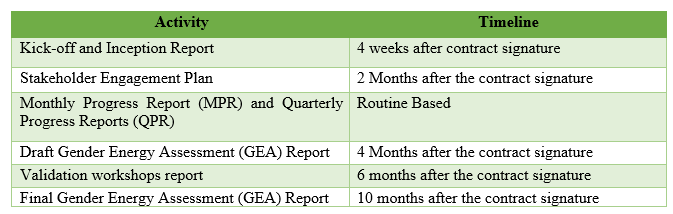
The selected Firm shall deliver the necessary support and the associated with the deliverance of the National Gender Energy Assessment final report rrequired under this ToR and an inception report will be expected within 4 weeks to be shared to the Client and there after deliver the listed activities as listed below within the following time frames:
- Implementation schedule
The Services under this assignment are expected to be conducted for a period of approximately twelve (12) calendar months. The consultant should demonstrate as part of the inception report how this timeline will be achieved, and any risks associated with doing so including in relation to security issues and Covid-19 as relevant.
Assignment Location
The implementation of this work will be under a direct oversight of The Ministry of Energy and Minerals (GoSL). The consultancy firm will be based in Hargeisa the Headquarters of the MOEM. The oversight will be done by the PIU and report to the project coordinator.
[i] There isn’t a national grid and electricity service providers operate in isolation to one another with a hybrid minigrid systems in place, therefore, transmission is considered at 33KV and distribution at 15KV/11KV.How to apply
Interested Consultant may obtain further information at the address below during office hours from 8:30am to 5:00pm Hargeisa time (Excluding public holidays).
Further information can be obtained by sending email requests at the email address below. Expressions of interest must be delivered (in person, by mail, or by e-mail) or in a written form in three (3) hard copies to the address below by not later than 5:30pm on 14th December 2022.
Attention: The Project Coordinator,
Ministry of Energy and Minerals
Somali Electricity Sector Recovery Project
Project Implementation Unit
Road #1, 26 June Avenue in Sha,ab Area,
Opposite the Presidential Palace,
Hargeisa, Somaliland
Republic of Somaliland

QaranJobs.com
………………………………………………………………………………………
PLEASE JOIN US – QARAN JOBS
Follow us on our Social Media:
Telegram: https://t.me/qaran_jobs
Facebook Page: https://www.facebook.com/QaranJobs.so
Facebook Group 1: https://www.facebook.com/groups/somaliajobs
Facebook Group 2: https://www.facebook.com/groups/qaranjobs
Linkedin: https://so.linkedin.com/company/qaranjobs
Twitter: https://twitter.com/qaran_jobs
Instagram: https://www.instagram.com/qaranjobs
Application: https://play.google.com/store/apps/details?id=com.qaran.jobs
To apply for this job email your details to procurement@moem-sl.com