 QaranJobs.com – somali jobs – somalijobs – qaranjobs – Qaran Jobs Somali Jobs
TAAKULO Somali Community (TASCO)
Terms Of Reference for Consultancy for Final Evaluation of SGBV Prevention and Entrepreneurship Integration Project in Burao
TERMS OF REFERENCE
Consultancy for final evaluation of SGBV Prevention and Entrepreneurship
Integration Project in Burao District, Togdheer Region
- BACKGROUND
Taakulo Somali Community is commonly known by the acronym “TAAKULO”. TAAKULO is a multifaceted non-governmental, non-profit-making, non-political and nonpartisan development and humanitarian aid organization established in 2007 and headquartered in Hargeisa, Somaliland, and has regional offices throughout Somaliland, Somalia, and Ethiopia.
TAAKULO organization was established to assist the Somali community, to whom time has tested their resilience to the tipping point, drought and famine scavenging their livelihood, war and conflict avenging their economy on the other hand. Projects are basically based on the needs of the communities in which they are implemented, where the beneficiaries always take part in the planning process. TAAKULO engages in a long-term commitment, and partnership approach with the beneficiaries in implementing the projects.
TAAKULO is seeking the services of a consultant to conduct final evaluation of the SGBV Prevention and Entrepreneurship integration project in Burao district Togdheer region. The project was implemented in 2020-22 in partnership with International Solidarity Foundation and aims to improve the livelihood status and prevention for vulnerable women and young girls affected by GBV/FGM in Burao District. The expected outcomes of the project are as follows:
- Outcome 1: There is a coordinated Anti-FGM and SGBV intervention among CSOs and government institutions in Burao District.
- Outcome 2: Grassroots community leaders and committees take an active role in ending FGM and SGBV within their communities.
- Outcome 3: Youth in the target IDP’s and villages mobilize against FGM and SGBV to the communities.
- Outcome 4:Target community members have attitudes supportive of ending FGM and SGBV
- Outcome 5:Self-Help Group members have strengthened self-esteem to develop their businesses and challenge harmful practices.
The direct beneficiaries (participants to project activities) include Local CSOs and government representatives, Community Management Committee (CMC) members, Religious and Traditional Leaders, youth and self-help-group (SHG)women. The final beneficiaries are all people in the targeted IDP camps, particularly women and girls.
- OBJECTIVE OF THE CONSULTANCY
The objective of the final evaluation is to examine the relevance, impact, efficiency, and sustainability of the project and to inform TAAKULO and ISF future interventions regarding women empowerment and FGM/SGBV prevention.The following key themes and research questions will guide the evaluation:
- Relevance (the extent to which the project is suited to the priorities and policies of the target group and the context)
- Was the project relevant to the identified needs?
- Were the inputs and implementation strategies realistic, appropriate and adequate to achieve results?
- Impact (changes that can be attributed to the project)
The examination should be concerned with both intended and unintended results and must also include the positive and negative impact of external factors.
- What real difference has the project made in the lives of the direct and final beneficiaries?
o Was the project effective in decreasing FGM and SGBV?
o Was the project effective in increasing the livelihood of vulnerable women?
- What were the major factors influencing the achievement of the project objectives?
- How do the final beneficiaries see the impact and describe the changes?
- How many people have been affected positively (directly versus indirectly)?
- Can the observed changes be attributed to the project? How?
- Efficiency (qualitative and quantitative outputs in relation to the inputs)
- Were the resources effectively utilized? What factors contributed to implementation efficiency?
- Did project activities overlap and duplicate other similar interventions (funded nationally and /or by other donors?
- What are the strengths, weaknesses, opportunities and threats of the selected implementation strategy?
o How did the FGM/SGBV prevention activities affect women’s livelihood activities/objectives?
o How did the livelihood activities affect women’s participation in FGM/SGBV prevention activities?
o How to make better use of the synergies between the two thematic priorities in the project?
- Could a different approach have produced better results (or same results more efficiently)?
- Effectiveness (extent to which a project attains its objectives / results)
TAAKULO team together with ISF local team will collect quantitative and qualitative endline monitoring data to evaluate whether the outputs and outcomes have been achieved (data will be available for the selected consultant). The evaluation will triangulate the endline monitoring dataandverify if
- the project has contributed to a coordinated Anti-FGM and SGBV intervention among CSOs and government institutions in Burao District (outcome 1)
- the grassroots community leaders and committees have takenmore active role to end FGM and SGBV within their communities (outcome 2)
- the youth in the target IDP’s and villages have mobilized against FGM and SGBV (outcome 3)
- the target community members have attitudes supportive of ending FGM and SGBV (outcome 4)
- the Self-Help Group members have strengthened self-esteem to develop their business and challenge harmful practices(outcome 5)
- Sustainability (are the benefits of the project likely to continue after the projectends)
- To what extent are the benefits of the FGMand SGBV interventions likely to be sustained after the completion of the project?
- What is the likelihood of continuation of the FGM and SGBV coordination within the diverse stakeholders after the completion of the project?
- Was the project sustainable in increasing the livelihood of vulnerable women?
- Was there any permanent change in targeted women’s human resources, such as new knowledge and skills, self-esteem?
- Were there any permanent changes in targeted women’s social resources, such as business contacts, advisory contacts, roles in family and roles in community
- Were there any permanent changes in targeted women’s material resources, such as incomes, assets and access to credit?
- What are the key factors that will require attention in order to improve the prospects of sustainability of the project outcomes and the potential for replication of the approach?
- Describe the main lessons that have emerged.
- METHODOLOGY
The methodology and tools will be developed by the consultant and presented in the inception report. The data collection should include variety of approaches, focusing on qualitative data collection methods including but not limited to:
- Desk review of background documents (project plan, project monitoring data including endline data report, 2020-21 annual progress reports, field visit reports etc.)
- Observations within the target communities
- Key informant interviews with field staff, key community members/beneficiaries, and representatives from the line ministries
- Focus group discussions (e.g. with stakeholders & community members)
- DELIVERABLES AND TIME FRAME
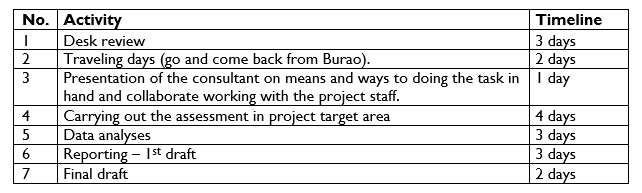
The consultant is expected to lead, accomplish and submit the following deliverables within the agreed timeframe and budget:
- An inception report which will serve as an agreement between parties on how the evaluation will be conducted. Items to address:
o Data sources; how to assess the questions in the ToR
o Methodology including suggested sample sizes and ethical considerations
o Appropriate validated draft data collection tools (e.g., methodological guidelines, group interview questions)
o Schedule of activities and traveling (timeline)
o Proposal for a learning event/validation of evaluation findings in Juba/Lakes o Detailed budget
- A max 30-page draft English final evaluation report (MS Word for and PDF for final), excluding annexes, and including the following elements:
o Executive Summary in bullets (max. 2 pages) o Introduction
o Methodology, including sampling and limitations o Findings and analysis
o Stories of change and quotes from respondents
o Conclusions for each of the end line evaluation objectives
o Recommendations drawn from the conclusions and informing future projects
o Concerns, lessons learned and comments from TAAKULO and ISF taken into account in the final version
o Annexes:
- Relevant maps and photographs of the evaluation areas where necessary
- Bibliography of consulted secondary sources
- Finalized data collection tools
- List of interviewees with accompanying informed consent forms
- PowerPoint presentation of preliminary findings to TAAKULO & ISF.
Skills and Qualifications
- At least Master’s degree in Development Studies, Humanitarian Leadership Program, or a related field
- At least 5 years’ experience in working with gender-based violence, women empowerment, and livelihood programs
- Demonstrated experience with qualitative research methods
- Experience of working in Somaliland.
- Experience of evaluating GBV programs
- Proven record of communicating with beneficiaries.
- Understanding of GBV policy, standards, and protocols
- Ability to assess and further develop a conceptual evaluation tool
- Relevant subject matter knowledge and experience regarding the thematic areas of this GBV and women empowerment project
How to apply
Along with the CV, interested candidates must submit the following documents to procurement@taakulo.org no later than 25th October 2022.
- A technical proposal explaining your comprehension of the TOR and how you would approach this, including a timeline.
- Two samples of similar previous assignments.
- Availability during October-December 2022
- A financial proposal outlining their expected fees, TAAKULO will provide the local transportation required.

QaranJobs.com
………………………………………………………………………………………
PLEASE JOIN US – QARAN JOBS
Follow us on our Social Media:
Telegram: https://t.me/qaran_jobs
Facebook Page: https://www.facebook.com/QaranJobs.so
Facebook Group 1: https://www.facebook.com/groups/somaliajobs
Facebook Group 2: https://www.facebook.com/groups/qaranjobs
Linkedin: https://so.linkedin.com/company/qaranjobs
Twitter: https://twitter.com/qaran_jobs
Instagram: https://www.instagram.com/qaranjobs
Application: https://play.google.com/store/apps/details?id=com.qaran.jobs
To apply for this job email your details to procurement@taakulo.org