 QaranJobs.com – somali jobs – somalijobs – qaranjobs – Qaran Jobs Somali Jobs
Muslim Aid Somalia
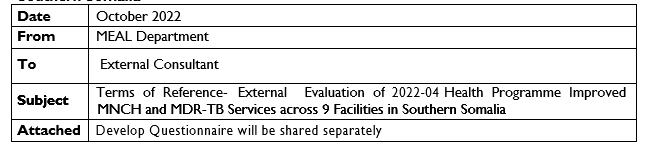
Terms of Reference for End-line evaluation of Project Evaluation of MA 2022 Health Programme Improved MNCH and MDR-TB Services across 9 Facilities in Southern Somalia
Terms of Reference for End-line evaluation of Project Evaluation of MA 2022 Health Programme Improved MNCH and MDR-TB Services across 9 Facilities in Southern Somalia
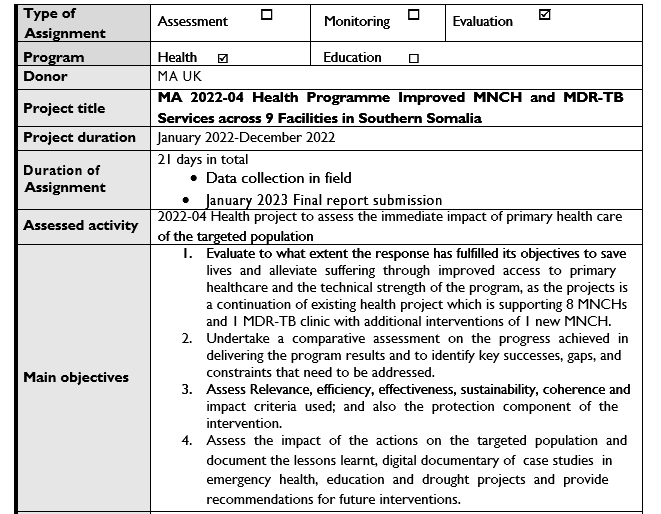
2022-04 Health Programme Improved MNCH and MDR-TB Services across 9 Facilities in Southern Somalia
- BACKGROUND
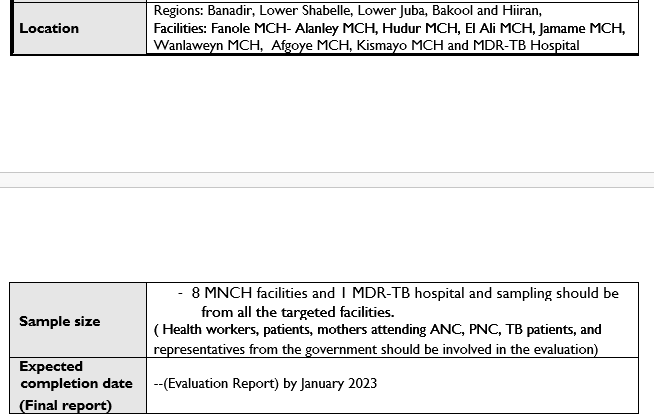
Muslim Aid supports 9 static health facilities (8 MNCHs and 1 MDR-TB) since 2022, with the projects based in Banadir, Bakool, Lower Shebelle, Hiran, and Lower Juba regions to provide quality primary health care services targeting women and children. Services planned include treatment of common morbidities, first aid and treatment of minor injuries, treatment of communicable diseases, maternal and new-born health (including comprehensive ANC, skilled delivery services, management of intrapartum complications for mothers and new-born, timely PNC), child health services (including the treatment of malaria, pneumonia, and diarrhea), health promotion and education, and immunization services. These facilities are further supported to monitor, track, and respond adequately to the trends in morbidities and potential outbreaks of communicable diseases such as measles and AWD caused by the protracted drought using a real-time health management information system (HMIS).
MA supports the health facilities with equipment, pharmaceuticals, medical supplies, staff, and infrastructure to be able to provide preventive, diagnostic, treatment, and referral services to ensure a comprehensive package is available to all patients. In addition, MA continues to ensure global standards for infection prevention and control procedures at all service delivery sites. Data generated in health facilities are collected in MOH-approved HMIS forms, transmitted through the district, regional to the national level where MA supports the analysis and use for decision-making. All health services are provided free of charge with no discrimination by gender, age, sex, status, or ethnicity.
Health: As a result of the drought, population displacement, and overcrowding in IDP camps, outbreaks of infectious diseases are common. MA’s response for drought is building on the recently ended MNCH/MDR health response with detection, response to potential outbreaks and provision of health services to affected populations as described in the Humanitarian Response Plan (HRP). Through an integrated approach, MA supports equitable access to emergency and essential health care services. By integrating services, especially with nutrition and WASH, actions will prevent individuals slipping back into malnourished and fragile health conditions. With the ongoing drought, increase in AWD/cholera outbreaks and deterioration of the nutritional status of children younger than 5 years is frequent. A scale up for detection and case management services for AWD/cholera and those severely malnourished with complications, is being done to save lives. Measles vaccination coverage, estimated below 50% in rural villages, is not enough to prevent measles outbreaks. Susceptibility to communicable diseases such as these is compounded by poor nutrition, low immunization coverage, and limited vector control interventions (Partners SCI Baseline Report 2020).
MA recognizes the need to sustain and further consolidate the humanitarian health assistance for IDPs and underserved rural populations and supports the Maternal Newborn and Child Health (MNCH) facilities and Multi-Drug Resistant Tuberculosis (MDR-TB) hospital through the provision of incentive
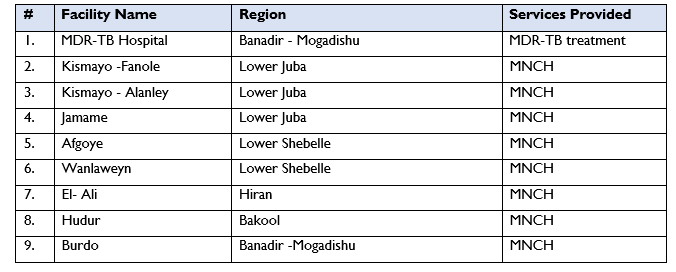
salary payments of health workers and providing running costs for the MNCH facilities and MDR-TB hospital. Additionally, Muslim Aid provides capacity building and quality assurance through support supervision and monitoring of health facilities on quarterly bases. Additionally, the MNCH facilities are provided with a monthly essential drug for the treatment of common illness at the facility. The targeted facilities are listed below: –
- PURPOSE
The purpose of the end line evaluation is to assess the overall performance, outcome and impact of the project with an aim of providing realistic and feasible recommendations for improving similar programs in Somalia context. The findings of the end line evaluation will be used as a post-test measurement of changes in the indicators attributable to the program interventions.
2a. SPECIFIC OBJECTIVES
The evaluation objectives include the following;
- Evaluate to what extent the response has fulfilled its objectives to save lives and alleviate suffering through improved access to primary healthcare and the technical strength of the program, as the projects is a continuation of existing health project which is supporting 8 MNCHs and 1 MDR-TB hospital.
- Undertake a comparative assessment on the progress achieved in delivering the program results and to identify key successes, gaps, and constraints that need to be addressed.
- Assess Relevance, efficiency, effectiveness, sustainability, coherence and impact criteria used; and also the protection component of the intervention
- Assess the impact of the actions on the targeted population and document the lessons learnt, digital documentary of case studies in emergency health, education and drought projects and provide recommendations for future interventions.
- EVALUATION CRITERIA
Following evaluation questions should be at least included in the evaluation criteria. These evaluation criteria are based on OECD DAC.
- Relevance
- To what extent are the objectives of the programme being valid for country programme and target community?
- Are the activities and outputs of the programme consistent with the overall goal and the attainment of its objectives?
- Are the activities and outputs of the programme consistent with the intended impacts and effects of its Strategy?
- Was the design of the project the most appropriate and relevant to promote the strategy?
- Effectiveness
- To what extent were the project objectives demonstrating progress on Core indicators?
- To what extent project achieved planned objectives and results?
- What were the major underlying factors (internal and external) influencing the achievement or non-achievement of the results within the one years of project implementation?
- To what extent technical input provided to the project team in leading the implementation of plans and proposed activities of the Programme?
- Efficiency
- Assess the activities are cost-efficient within the programmes supported by project?
- Does the Project offer better value for money within the rural and urban context in terms of its impact?
- Identify the cost factors spent to deliver interventions in the urban and rural community and identify the reasons behind budget underspent
- Impact
- What are the key short term and long term changes produced by project, positive or negative and what are the key factors behind these changes?
- What real difference has the project activities made for the direct, and indirect stakeholders of promoting HEALTH/interventions?
- Sustainability
S1) to what extent did the benefits of the projects continue after the fund support is ceased?
S2) what were the major factors which influenced the achievement or non-achievement of sustainability of the project?
- Coordination
- How have the project activities been coordinated within different stakeholders to achieve overall objective?
- Scalability/Replicability
- Is there any likely ability of the project or its components to be scaled or replicated in other programme areas?
- Who are the main actors in the scale-up/replication of the approach in other urban and rural locations and how has the project engaged with them to date?
4.1 METHODOLOGY
The lead consultant with the other team members will develop the evaluation methodology in collaboration with Health team and Senior Programs Manager. The lead evaluator or team is expected to write an inception report following review of literature and reference documents using the guidance format provided by MA Somalia.
Such a methodology should define an appropriate sample size and specify mechanisms that will be adopted to avoid selection bias. The lead evaluator will be expected to utilize various data collection tools like questionnaires, key informant interviews guides, observation to obtain data from the various respondents and key stakeholders. As a minimum, the evaluation process will include the following key steps:
- Gender balance in respondents or sample size, with a margin of 10% flexibility.
- Review of relevant literature related to the project (c.f. list of reference materials) and drafting an inception report;( proposal, quarterly reports, monitoring reports, budgets among others)
- Data collection to apply-appropriate data collection tools (e.g. questionnaire, checklist etc.) for Interviews and focus group discussion;
- Data analysis and Evaluation Report writing; and
- Presentation of key evaluation findings;
- Program Indicators to be evaluated
The program intends to assess the following principal indicators from Project;
- Percentage of pregnant women who have attended at least two comprehensive antenatal clinics
- Percentage of newborns that received postnatal care within three days after delivery
- Percentage of births assisted by a skilled attendant at birth
- Percentage of pregnant women in their third trimester who received a clean delivery kit
- Number and percentage of community members who can recall target health education messages
- Number of people admitted, rates of recovery, default, death, relapse, and average length of stay for people admitted to Management of Acute Malnutrition site
- Proportion of infants 0-5 months of age who are fed exclusively with breast milk
- Percentage of targeted population whose health status improved as a result of the intervention
- Percentage of people adopting safe health behaviour, attitude, and practices after participating on trainings and awareness sessions
- Number of established activities or practices to ensure inclusion of PWD participation during the project cycle
- Number of established activities or practices to ensure inclusive of women participation during the project cycle
- Percentage of individuals in targeted areas with a positive perception regarding the intervention
4.2. REFERENCE MATERIAL
- Project Technical Proposal(year) 2022
- Monitoring and Evaluation Plan for (year) 2022
- Performance indicators – log frame
- Quarterly reports
- Monitoring reports
4.3 EVALUATION TEAM
The evaluation shall be conducted by an external evaluator or evaluation team, selected through competitive proposal submission process. The following are minimum requirements for the team/consultant to be considered for carrying out the assignment
- At least a Master degree in Project management, Statistics or Media Production any other related fields
- Minimum of 5 years’ relevant professional experience in conducting evaluations for Health programs
- Strong experience in conceptualizing and evaluating MA funded programs preferably in the context of Somalia
- Excellent communication and report writing skills.
- AWARD CRITERIA
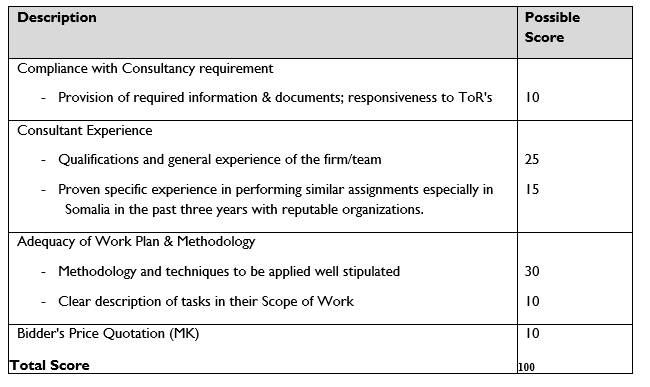
The following award criteria will be used during the evaluation of the proposals: –
- TIME-FRAMES
Time frame for the activities will be December 2022 – January 2023.
5a. Timeframe and activities
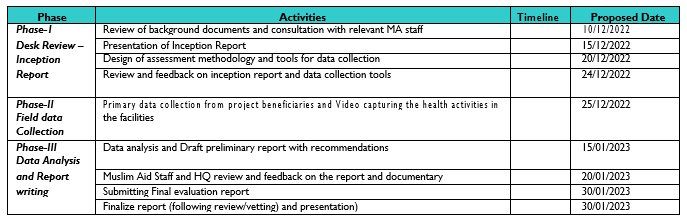
-The evaluation should be completed over a period of approximately 21 days working days from
December 10, 2022 Illustrative activities and timeline are provided below:
5.1. DURATION OF ACTIVITIES
The duration of the evaluation exercise in the field shall be 10 days from a mutually agreed date no later than January 30, 2023.
The evaluation will follow the key phases:
Phase I – Desk study: Review of documentation and elaboration of field Study
The lead consultant/evaluation team will review relevant documentation from section 5 above (Reference material). Based on this review, they will produce an inception report which will include an elaborate plan, methodology and sampling strategy of the data collection for evaluation study. The evaluation will only proceed to the next stage upon approval of this inception report. An appropriate inception report format will be provided to the team later on.
Phase II: Field Data Collection
This phase of the evaluation will seek to collect primary data on the key evaluation questions explained under evaluation criteria. The consultant is responsible for the preparation of the team who will collect the evaluation data and will use the agreed plan, methodology and sampling strategy from phase-1 to conduct the field work. The consultant will also oversee the media crew to capture the work in the facilities and interviews with the community for purposes of showcasing the impact of the health interventions on the community.
Phase III – Data analysis and production of evaluation report
The team will draw out key issues in relation to evaluation questions and produce a comprehensive report. This analysis should draw on the wider issues in the development sector about the realisation of child rights beyond the focus of Strategic Fund.
6.0 OUTPUT AND DELIVERABLES
The following specific outputs are expected –
- An Inception report, produced by no later than December 15, 2022
- A draft evaluation report produced by no later than January 20, 2023
- A Final evaluation report including country case studies and recommendations for Country Programme for future use of Programme design and/or alternative solutions to achieve the same objectives produced by January 30, 2023
- Data sets (SPSS, Excel) – for all collected data (quantitative and qualitative). Qualitative data should be transcribed for future use by Muslim Aid Country Programmes. The data sets should be in an appropriate format (SPSS, Excel, and Word) and will be submitted together with the final evaluation report
- PowerPoint presentation, summarizing the key findings from the evaluation submitted together with the final evaluation report on January 30, 2023.
- A 5-10-minute video documentary case study showcasing the work of Muslim Aid across the various projects and the impact it has had on the community
6.1 INCEPTION REPORT
The evaluation team is expected to submit an inception report after 5 working days of commencing this evaluation, no later than December 15, 2022. The inception report provides the organization and the evaluators with an opportunity to verify that they share the same understanding about the evaluation and clarify any misunderstanding at the outset. The report should reflect the team’s review of literature and the gaps that the field work will fill. Field work will only commence once this report has been reviewed and agreed with the designated representatives of the Stakeholders.
6.2 DRAFT REPORT
The draft evaluation report must be submitted to the Country Director/Head of programme no later than January 20, 2023. The report should conform to a reporting format which will be made available to the consultant on signing the contract.
The draft report will be circulated by the designated representatives to key stakeholders for comments.
Feedback on the draft report will be shared with the consultant no later than January 25, 2023.
6.3 FINAL REPORT
The final report of the evaluation, after integration of the various comment made, must be submitted by January 30, 2023. The evaluation report is an exclusive property of the Muslim Aid should not be released without prior authorization. The final report will be available through Muslim Aid and will also be circulated to the country Programmes:
6.4 DATA SETS
The evaluation team will be expected to submit complete data sets (in /STATA/SPSS/Access/ Excel) of all the quantitative data as well as the original transcribed qualitative data gathered during the exercise. These data sets should be provided at the time of submission of the final report.
6.5 SUMMARY FINDINGS
On submission of the final report and the documentary, the team is expected to submit a PowerPoint presentation (maximum 12 slides), summarizing the methodology, challenges faced, key findings under each of the evaluation criteria and main recommendations. This should be submitted together with the final report.
- SUGGESTED REPORT FORMAT
Detailed guidelines on how to structure the evaluation report will be provided to the evaluation team prior to commencement of the activity. The team should conform to this format
- MA Somalia Responsibilities
The MA Somalia will be responsible for the following:
- Ensure effective coordination of the end line process.
- Linking the team with the key organizations/stakeholders and districts that will be consulted during the evaluation.
- Approve inception report
- Providing input into the tools developed, and evaluation design.
- Provide consultants with literature review materials/necessary documentations.
- Link consultants to relevant stakeholders
- Reviewing analysis of the data collected prior to the documentation of the final report
- Review draft report
- Approve and signoff final report draft
- Ownership of Research Data/Findings
All data collected and report findings for this study shall remain the property of the MA Somalia.
- ADMINISTRATIVE/ LOGISTICAL SUPPORT
10.1. Budget
- The lead evaluator should submit to Muslim Aid forecast of the budget including their consultancy fees. Cost of flights between countries (Economy class). In-country transportation, hotel accommodation, Stationery and supplies will be covered by MA. Currency used in the budget should be US Dollars.
10.2. SCHEDULE OF PAYMENT
The following payments will be made to the consultant using and agreed mode of payment.
- Before Commencement: 20%
- After First draft: 30%
- After Final Report is approved by Muslim Aid (including HQ): 50%
How to apply
Muslim Aid invites technical and financial proposals from qualified consultants. Applications Interested candidates should present an application, as follows:
- A Technical application detailing: – Understanding of the ToRs, methodology, CVs of the Team Leaders and technical reference of previous similar works
- A Financial proposal with a detailed budget taking considering the details in the ToR and timelines therein.
- Application Submission address: somaliarecruitment@muslimaid.org indicating “Final evaluation for Project” as the subject. Deadline for submission is November 10, 2022.

QaranJobs.com
………………………………………………………………………………………
PLEASE JOIN US – QARAN JOBS
Follow us on our Social Media:
Telegram: https://t.me/qaran_jobs
Facebook Page: https://www.facebook.com/QaranJobs.so
Facebook Group 1: https://www.facebook.com/groups/somaliajobs
Facebook Group 2: https://www.facebook.com/groups/qaranjobs
Linkedin: https://so.linkedin.com/company/qaranjobs
Twitter: https://twitter.com/qaran_jobs
Instagram: https://www.instagram.com/qaranjobs
Application: https://play.google.com/store/apps/details?id=com.qaran.jobs
To apply for this job email your details to somaliarecruitment@muslimaid.org